Yes, under Article 8 of the Fire Safety Order, they would be considered part of maintaining the “General Fire Precautions”.
Fire Door FAQs
Fire doors are typically required to protect escape routes or to divide a building into fire compartments, thereby limiting the spread of fire and smoke. This ensures that occupants have sufficient time to make a safe escape. Consequently, fire doors are usually mandated at the top and bottom of staircase enclosures. Enhanced protection is especially crucial in buildings where people sleep, such as hotels and apartment blocks.
Following the introduction of the fire safety England regulations, doors in residential buildings over 11m in height are now required to conduct communal fire door inspections 4 times a year (quarterly) and flat entrance doors are required to be inspected once a year on a best endeavors’ basis
While anyone can perform a basic check on a fire door, only third-party certified companies can provide a certificate of significant standing. Since the Grenfell Tower tragedy, the role of third-party certified surveyors has become essential for commercial buildings.
Legislation around fire door safety is extensive, and doors that appear to be in good working order may still be compromised. Having your fire doors inspected by a qualified, third-party assessed, and certificated professional not only provides peace of mind but also demonstrates a serious commitment to fire safety.
As the Responsible Person under the Regulatory Reform (Fire Safety) Order 2005, you are accountable for ensuring that fire doors and frames are correctly installed and capable of stopping a fire. At VeriFire, we understand the challenges of your daily role and the added complexity of fire door safety. We can alleviate this burden by providing qualified inspectors to assess your fire doors and frames, delivering clear information on any necessary corrective actions.
As the Responsible Person, it is your duty to ensure that a suitable and sufficient fire risk assessment (FRA) is conducted. While an FRA typically includes a review of the condition of existing fire doors, it often involves only a sample of doors rather than an exhaustive inspection.
Sampling can highlight significant issues, such as improperly fitting doors and obvious signs of damage, but it does not cover all potential problems. Therefore, a more comprehensive fire door inspection is usually required to ensure all doors and frames are in proper condition, providing thorough safety and compliance.
Yes, it is a legal obligation. Article 17 of the Regulatory Reform (Fire Safety) Order 2005 (FSO) requires that fire-resistant and escape doors are correctly installed and adequately maintained to ensure they are fit for purpose. Regulation 38 of the Building Regulations (England and Wales) links these regulations to the FSO for applicable buildings. Additionally, the Fire Safety Act 2021 emphasizes that flat entrance doors fall under the responsibility of the “Responsible Person.”
The FSO applies to all buildings except domestic housing and replaces 118 previous fire legislation pieces, including the old fire certificate. Responsibility for fire safety now lies with those who have day-to-day control of the premises, rather than fire authorities. These authorities have the power to enforce the FSO and can prosecute or close buildings down if breaches are found.
For buildings over 11 meters in height, the Fire Safety (England) Regulations 2022 require the Responsible Person to make best efforts to check fire doors at the entrances of individual flats at least once every twelve months. Additionally, fire doors in communal areas must be checked every three months.
While there is no legal obligation to conduct regular fire door inspections for buildings under 11 meters in height, you are still required to ensure that fire-resisting doors are adequately maintained to be fit for purpose. Article 17 of the Regulatory Reform (Fire Safety) Order 2005 (FSO) mandates this maintenance. Therefore, having an inspection can help ensure compliance and the safety of your building.
Following the Grenfell tragedy, the concept of the “golden thread of information” was introduced. It is now the responsibility of the “Responsible Person” to establish and maintain this thread, which focuses on the collaborative sharing of information about high-rise residential buildings.
The golden thread ensures that information is easily accessible, reliable, accurate, and up-to-date. It serves as the definitive source of information for a building, available to those who need it, when they need it, and presented in a usable format.
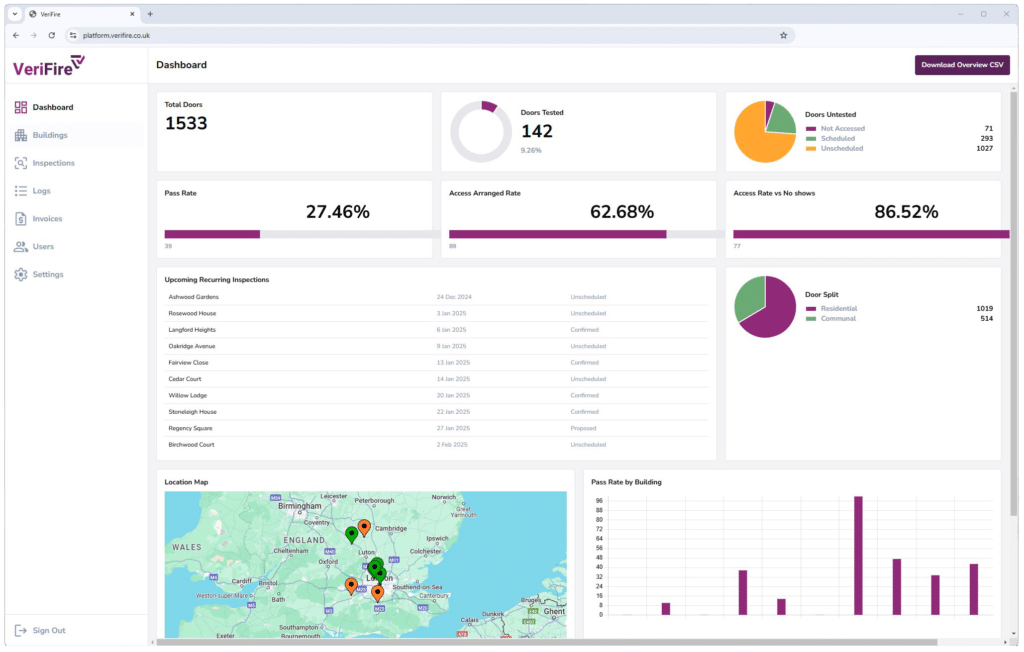
By using VeriFire’s digital portal, you can keep all aspects of the report and clear records of fire door inspections at your fingertips, ensuring compliance and enhancing safety.
“Best endeavours” in Regulation 10 of the Fire Safety (England) Regulations 2022 means that responsible parties must take all reasonable steps within their power to comply with the fire safety requirements. This includes making every effort, utilizing all available resources, and demonstrating a proactive approach to meeting the regulatory standards. It implies a high level of diligence and commitment to ensure compliance, going beyond minimal efforts or superficial measures.
One of the reporting options at VeriFire is the “Best Endeavours” report, which details all attempts to contact residents, complete with timestamps, using various mediums such as SMS and email demonstrating you have met the required level of diligence required by legislation.
All of our engineers and inspection partners are DBS-checked.
Our fire door inspectors conduct comprehensive, non-destructive fire door surveys and deliver detailed reports on the condition of the entire doorset.
A non-destructive and non-intrusive survey comprising:
- a comprehensive visual inspection of each fire resisting doorset including:
- the fire resisting qualities of the fire door hinges and all door hardware
- the condition, fitting, and operation of the hinges and hardware
- a review of fire door signage
- a check of the condition and operation of any hold open devices
- a check of the fire door closing devices and their ability to effectively close the doorsets
- a check for relevant markings, for example from the British Woodworking Federation to identify the fire rating of the doorset
- an inspection of the locks and latches to ensure they are operational
- an inspection of any vision panels, glazing, and review of their suitability
- an inspection of the cold smoke seals
- an inspection of the intumescent strips
- an assessment on the fire resisting qualities of the doorset, including its thickness
- a review of the gaps between the leaf and frame – including the threshold for suitability
- a visual inspection of the fire door frame
- a visual inspection of the door leaf
- a review of the materials used in the installation of the doorset
- a clear action plan which outlines the locations of defects, photographic evidence, and suggested remedial actions.
Fire resisting doorsets are a vital passive fire protection measure designed to limit the spread of fire and smoke from one area to another and often provide a safe means of escape by providing protection to escape routes.
80% of deaths from fire are because of smoke inhalation, which is why it is so important that fire doors are installed correctly, regularly inspected and maintained
Fire doors are typically required to protect escape routes or to divide a building into fire compartments, thereby limiting the spread of fire and smoke. This ensures that occupants have sufficient time to make a safe escape. Consequently, fire doors are usually mandated at the top and bottom of staircase enclosures. Enhanced protection is especially crucial in buildings where people sleep, such as hotels and apartment blocks.
The fire resistance of a door varies based on its specification:
FD30 – 30 minutes fire resistance
FD60 – 60 minutes fire resistance
FD90 – 90 minutes fire resistance
FD120 – 120 minutes fire resistance
If a suffix “s” is added (e.g., FD30s), it indicates that the door is fitted with intumescent strips and seals to enhance its performance.
Regular inspection of fire doors is crucial to ensure they are in proper working order, maintaining their effectiveness as lifesaving tools in the event of a fire. Every component of a fire door can impact its performance and compliance, so inspection reports must be thorough and comprehensive.
Fire doors are exposed to various factors that can compromise their performance over time. Accumulation of dirt, damage to seals, or misalignment can reduce their effectiveness in the event of a fire. Regular inspections help identify and address these issues promptly, ensuring the doors maintain their integrity and effectiveness.
In some cases, fire doors can be repaired using approved techniques, but this depends on several factors and expert advice should be sought. VeriFire provides a remedial action report with industry recognized ART codes (Accepted Repair Techniques).
The primary purpose of fire-resistant doorsets is to help prevent the spread of smoke and flames during a building fire. These doors work in conjunction with fire-resistant compartmentation to subdivide the building, enhancing overall fire protection and safety.
Yes, fire doors are typically necessary for flat entrance doors to protect escape routes and common areas from smoke and fire. Additionally, fire doors may be required within a flat due to its layout or specific escape challenges.
Fire doors are typically required to protect staircases, subdivide corridors, and secure high-risk areas such as plant rooms and lift motor rooms.
Not all fire doors must be self-closing; some may remain locked shut instead. However, doors located in escape routes or those safeguarding staircases typically are self-closing to prevent the spread of fire and smoke in these critical areas.
VeriFire affixes a QR code of the each door that is inspected. Both QR codes and digital record-keeping make achieving the ‘golden thread of information’ requirement easier than ever.
Yes, one of our report options is a basic report listing each non-compliant and compliant fire door
Yes, one of our report options is a remedial action report which contains industry recognized BMTRADA ART’s
(Acceptable Repair Techniques).
VeriFire provides a “Best Endeavours” report, which details all attempts to contact residents, complete with timestamps, using various mediums such as SMS and email demonstrating you have met the required level of diligence required by legislation.
Can’t find your questions?